
I always try to give the reader the experience of tasting the wine, which oddly enough, lines up with the WSET wine assessment criteria. First, you describe the appearance, color and intensity, then the aromas (nose), then the flavors in the drink (palate), and the finish: Short, Medium-, Medium, Medium+, Long. Quality level: Faulty, Poor, Acceptable, Good, Very Good, Outstanding. Drinking readiness: Too Young, Potential for Aging, Drink Now (not suitable for aging), or Too Old.
All wines fit into this assessment criteria, and by using it you will quickly realize that wine tasting is subjective, not objective.
Wine colors are as follows: Intensity is either pale, medium or deep. For whites it’s lemon-green, lemon, gold, amber or brown. For Rose’s it’s pink, salmon or orange. For reds it’s purple, ruby, garnet, tawny or brown.
Nose intensity is either light, medium-, medium, medium+ or pronounced.
For development it’s is either youthful, developing, fully developed or past its prime.
Palate flavor intensity uses the same scale a nose intensity.
Sweetness scale is dry, off-dry, medium dry, medium sweet, sweet, or luscious.
Both acidity and tannin have the same scale: low, medium-, medium, medium+ or high.
Alcohol content is either low (<12%), medium or high (>14%).
Body is either medium-, medium, medium+ or full.
Finish is either short, medium-, medium, medium+ or long.

There are many primary flavor descriptors. When assessing wine, one should start with the floral aromas on the nose: acacia, honeysuckle, chamomile, elderflower, blossom, rose petals, violet, etc,
For white wines: (green fruit) apple, gooseberry, pear, pear drop, quince;
(citrus fruit) grapefruit, lemon, lime, (fruit or zest) orange peel, lemon peel;
(stone fruit) peach, apricot, nectarine, (tropical fruit) banana, lychee, mango, melon, passion fruit, pineapple.
For red wines: (red fruit) red currant, cranberry, raspberry, strawberry, red cherry, red plum; (black fruit) black currant, blackberry, black cherry, black plum, bramble; (blue) blueberry, huckleberry; (dried fruit} fig, prune, raisin, kirsch, dried blueberry, etc.
(Herbal/Herbaceous): bell pepper, grass, tomato leaf, asparagus, eucalyptus, mint, medicinal, lavender, fennel, dill, etc.
(Spice) black pepper, white pepper, green peppercorn, licorice, tamarind, cardamon, etc.
(Other) flint, wet stones, wet wool, gravel, etc.
Secondary aromas and flavors:
(Yeast, lees, autolysis) biscuit, bread, toast, brioche, cheese.
(Malolactic Conversion (MLC)) Butter, cheese, cream.
(Oak) vanilla, cloves, nutmeg, coconut, butterscotch, toast, cedar, smoke, chocolate, coffee, etc.
Tertiary aromas and flavors:
(Oxidized – Orange wine or Port) almond, marzipan, hazelnut, walnut, chocolate, coffee, toffee, caramel, molasses, brown sugar.
(Bottle aged white) petrol, kerosene, cinnamon, ginger, nutmeg, mushroom, nuts, hay, honey.
(Bottle aged red) leather, forest floor, earth, mushroom, tobacco, vegetal, wet leaves, meat, barnyard.
There are many other descriptors, these are some of the main ones. They are not necessarily held to each category either. I’ve had white wines with a cherry flavor, and red wines with orange peel. The main thing is to recognize what you taste.
A simple wine may have only a few aroma and flavor descriptors. A more complex wine will have many more. Try to identify at least 5 aroma and flavor descriptors if it is a more complex wine. Happy tasting! Now you can taste like a pro!
Special Acknowledgment
I would like to take the time to give special recognition to my mentor Master Sommelier Peter Neptune. I studied under Peter for my WSET1, WSET2, WSET3, and French Wine Scholar Certifications. There are only 293 Master Sommeliers in the world, and Peter is one of them. Peter runs a wine school in Costa Mesa, Neptune School of Wine. He also has a YouTube Channel, Master Sommelier Peter Neptune, where he reviews different wines. One time our Level 3 class talked him into reviewing Grocery Outlet (Gross Out) wines, so he did. Actually, he’s done that twice now, and has taken one for the team by reviewing Aldi wines as well. A great guy, with a great sense of humor, and his wine assessments are spot-on. We hit it off as we are near the same age, were both disc-jockeys in our college years, and have a fond appreciation for prog-rock, classic rock, and The Firesign Theatre. He was the host of a “Colors of Provence” AMA wine cruise that went north up the Rhone River in France from Provence to Hermitage to Lyon. Fun times. I have a great respect for Peter. Check out his YouTube channel if you get a chance.
.
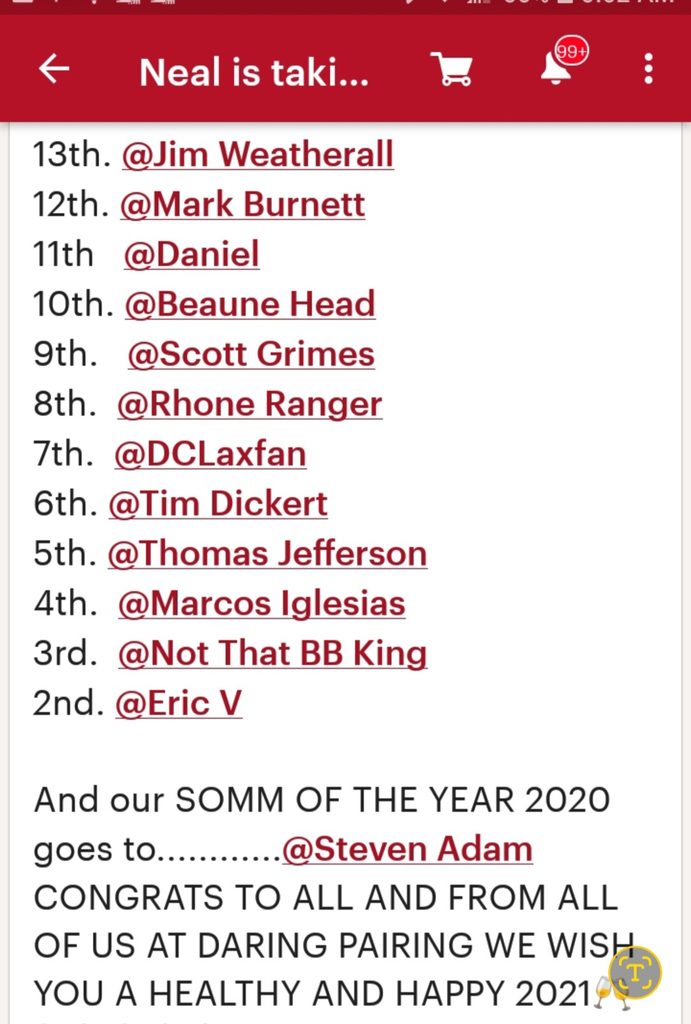
I won the Somm of the Year in 2020 for Daring Pairings, before I ever took a formal wine class. Each day they would show you a plate of food and you would have to pick a wine to pair with it. I did this for fun, and for extra fun, I selected only wines that were in my cellar. The entries from the 40 contestants were sent to a team of seven international judges, who would give a bronze, silver, or gold award for the day. I kept finding myself on the podium throughout the year. Near the end of the year, I was notified that I was in the running for Somm of the Year. So, I entered the challenges for the last two weeks, and the following January I was notified I had won. I was more surprised than anyone.